In a world that rarely slows down, most of us spend our lives searching for peace. We look for it in career success, financial security, relationships, or self-improvement. Yet, even when everything seems fine on the surface, an underlying sense of restlessness or spiritual distance often remains.
The Bible explains that true peace isn’t just a state of mind or the absence of trouble, it is a restored relationship with God.
Here is a simple, 4-step framework based on classical biblical teaching to help you understand God’s plan for your life and how you can experience true peace today.
Step 1: God’s Purpose — Peace and Life
God created you with intentionality and purpose. His original design for humanity was not one of confusion, fear, or spiritual isolation, but of lasting peace and eternal life.
God doesn’t view you as a distant observer; He desires a direct, personal relationship with you.
“We have peace with God through our Lord Jesus Christ.” — Romans 5:1
“For God so loved the world that He gave His one and only Son, that whoever believes in Him shall not perish but have eternal life.” — John 3:16
Why Don’t Most People Have This Peace?
If God designed us to experience His peace and life, why is the world filled with so much strife, anxiety, and spiritual emptiness?
Step 2: Our Problem — Separation
The reason we lack inner peace is that humanity chose to turn away from God.
The Bible calls this intentional independence sin. Sin isn’t just major moral failures; it is our decision to ignore God’s wisdom, live by our own standards, and put ourselves at the center of our lives.
Our sin creates a deep, spiritual divide between us and a Holy God.
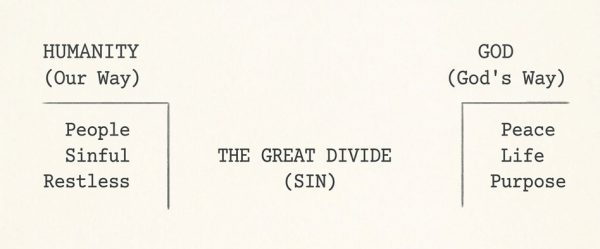
The consequence of this separation isn’t just a feeling of inner emptiness now; it leads to ultimate spiritual death and permanent separation from God.
“For all have sinned and fall short of the glory of God.” — Romans 3:23
“For the wages of sin is death…” — Romans 6:23a
Step 3: God’s Remedy — The Cross
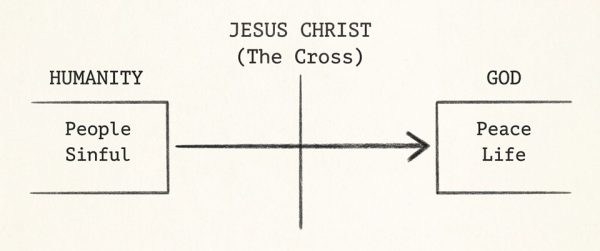
No human effort, whether good deeds, personal morality, or religious rituals, can bridge the gap caused by sin. Because we were unable to reach God through our own efforts, God came to us.
God sent His Son, Jesus Christ, to bridge the divide. Jesus lived a sinless life and willingly took our place on the cross, paying the full penalty for our sin. Through His death and resurrection, He established the only path back to God.
“But God demonstrates His own love for us in this: While we were still sinners, Christ died for us.” — Romans 5:8
“For there is one God and one mediator between God and mankind, the man Christ Jesus.” — 1 Timothy 2:5
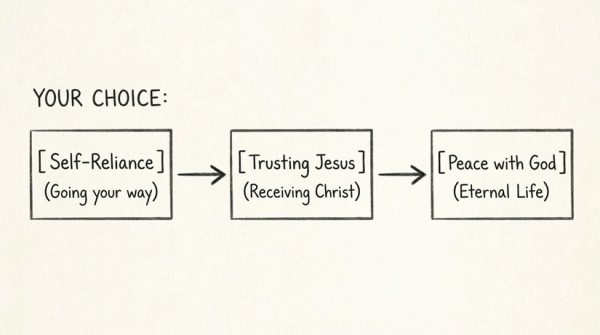
Step 4: Our Response — Receiving Christ
Knowing these three steps isn’t enough; you must make a personal choice to accept what Jesus has done for you.
Receiving Christ means trusting Him for the forgiveness of your sins and turning from self-reliance to follow Him. It is an act of genuine surrender and faith.
“Here I am! I stand at the door and knock. If anyone hears my voice and opens the door, I will come in…” — Revelation 3:20
“Yet to all who did receive Him, to those who believed in His name, He gave the right to become children of God.” — John 1:12
How to Receive Christ Today
You can invite Jesus into your life right now through a simple, sincere prayer. Remember, it is not the specific words that save you, but the faith in your heart.
“Lord Jesus, I know that I am a sinner and that I need Your forgiveness. I believe You died on the cross for my sins and rose from the dead. I turn from my sin and invite You to come into my heart and life. I want to trust and follow You as my Lord and Savior. Thank You for giving me eternal life and Your peace. Amen.”
Next Steps for Living in Peace
If you prayed this prayer today, you have begun an eternal relationship with God! Here are three steps to help you ground your faith:
- Read the Bible: Start reading a chapter a day in the Gospel of John to learn about Jesus.
- Talk to God: Pray daily, sharing your concerns, gratitude, and daily needs with Him.
- Join a Local Church: Connect with a Bible-believing local church to grow alongside other believers.
Attribution Note: Text framework adapted from “Steps to Peace with God,” published by the Billy Graham Evangelistic Association.